Home/Technical Library
Technical Library

Types of Bugging Devices & Surveillance Threats

A practical UK guide to listening devices, telephone interception, concealed recorders and modern wireless surveillance—and why professional TSCM must consider more than one type of transmitter.

Bugging Device Guide

Different types of bugging devices and how they work

The word bug covers many technologies. Some transmit sound by radio, cellular or Wi-Fi; others store recordings locally, use wires, exploit telephone or network systems, or collect sound from outside the room. A device may transmit continuously, only when sound is present, on a timed schedule or after remote activation.

This overview explains the principal categories at a level useful to clients assessing a concern. It does not describe how to install, configure or conceal surveillance equipment. Unauthorised interception and recording may be unlawful.

Radio-frequency transmitter

VHF and UHF radio bugs

A microphone converts room sound into an electrical signal that is carried on a radio transmission. Traditional examples use VHF or UHF frequencies and may transmit continuously or only when activated. The signal must be received somewhere within its usable range.

Cellular surveillance

GSM, 3G, 4G and cellular bugs

These devices use a mobile network rather than a nearby dedicated receiver. Depending on their design, they may answer or initiate a call, or transfer audio or data through a cellular connection. They can operate over much greater distances wherever compatible network coverage is available.

Network-connected device

Wi-Fi and IP audio bugs

A microphone or recorder connects to a wireless or wired data network and sends audio using internet protocols. Some are purpose-built; others may be compromised consumer or office devices. Investigation may therefore involve both the radio environment and the local network.

Short-range wireless

Bluetooth and other short-range bugs

Short-range wireless links can carry audio or retrieve stored data over a limited distance. Their low power and intermittent operation may make them less obvious than a continuously transmitting analogue radio bug.

Physical connection

Wired microphones and wire taps

A concealed microphone can carry audio through a cable to another location, recorder or transmitter. Because the listening path itself may not radiate a radio signal, physical inspection, cable tracing and electronic examination can be important.

Telephony interception

Telephone taps

Traditional telephone taps obtain audio or signalling information from a telephone line, extension, handset or associated wiring. Modern office telephony may instead use digital or VoIP systems, so telephone security can involve hardware, PBX configuration, networks and account access.

Stored audio

Miniature digital voice recorders

A recorder stores conversations internally for later recovery rather than transmitting them. It may record continuously, start when sound is detected or operate on a schedule. As no live RF link is required, spectrum monitoring alone cannot exclude this category.

Structure-borne sound

Contact microphones

A contact microphone responds to vibration travelling through a solid surface rather than ordinary airborne sound. It can be used to assess sound conducted through walls, glass, pipes or other structures, depending on the construction and acoustic conditions.

Acoustic collection

Listen-through-wall devices

These devices amplify vibration or sound transmitted through a wall or other partition. Their effectiveness depends heavily on the building materials, background noise and the physical access available on the other side of the structure.

Optical surveillance

Laser and optical microphones

An optical system may attempt to recover speech from very small vibrations of a reflective surface, often from outside the room. This is a different threat from an implanted radio bug and brings windows, lines of sight and acoustic protection into the assessment.

Power and cabling

Mains-carrier and cable-borne bugs

Some devices use existing power wiring or another conductor as part of the signal path rather than relying only on a conventional over-the-air transmission. Relevant circuits and connected equipment may therefore require examination.

Intermittent transmission

Burst, digital and frequency-agile bugs

Modern transmitters may send short bursts, use digital modulation, change frequency or remain dormant for long periods. A brief check with a basic detector can miss activity that requires longer observation and experienced signal analysis.

Concealment method

Trojan horse bugs

In physical surveillance, a Trojan horse bug is concealed inside an apparently legitimate object that is introduced into the target environment. The carrier object might appear to be office equipment, a charger, clock, power accessory, gift or other everyday item. The surveillance element inside could be a transmitter, cellular device, recorder, camera or combination of technologies. The term should not be confused with a software Trojan, although compromised computers, phones and smart devices can also be used for audio surveillance.

Compromised technology

Phones, computers and smart devices

A legitimate device with a microphone—such as a phone, laptop, conferencing unit or connected appliance—may present a surveillance risk if it is compromised, misconfigured or accessed without authority. This overlaps with cyber security and may require specialist digital investigation alongside TSCM.

Audio and video

Hidden cameras with microphones

Many covert cameras also capture sound or connect to a wireless network. Camera investigation may therefore involve optical inspection, network review, RF analysis and examination of apparently ordinary objects or fittings.
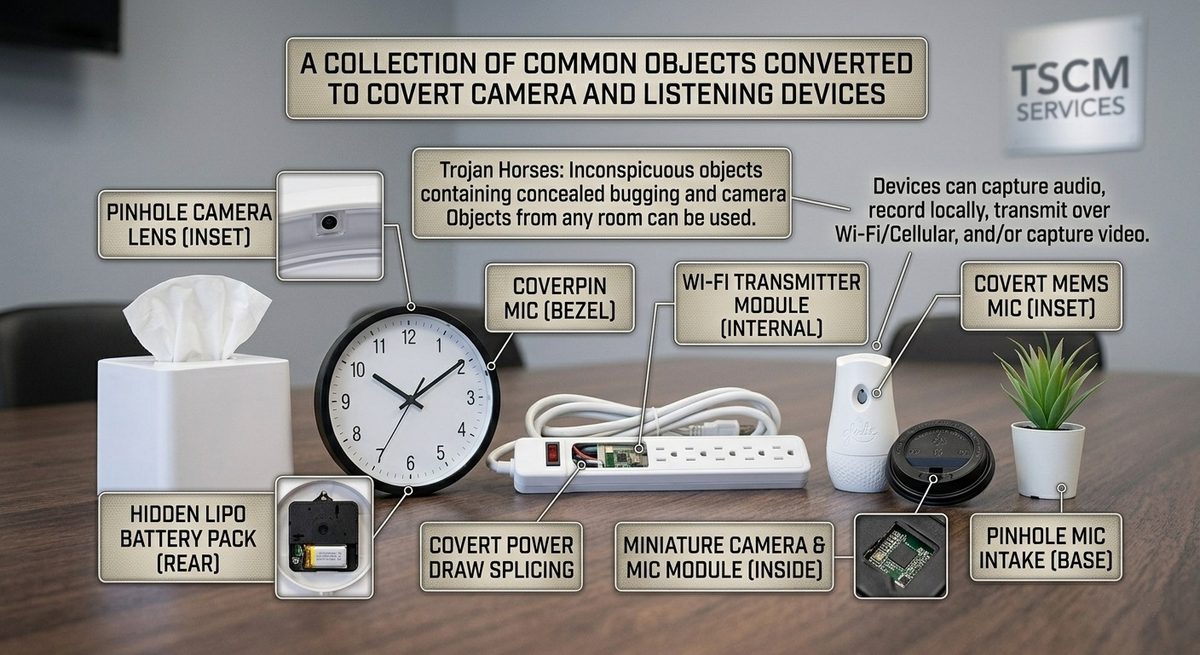
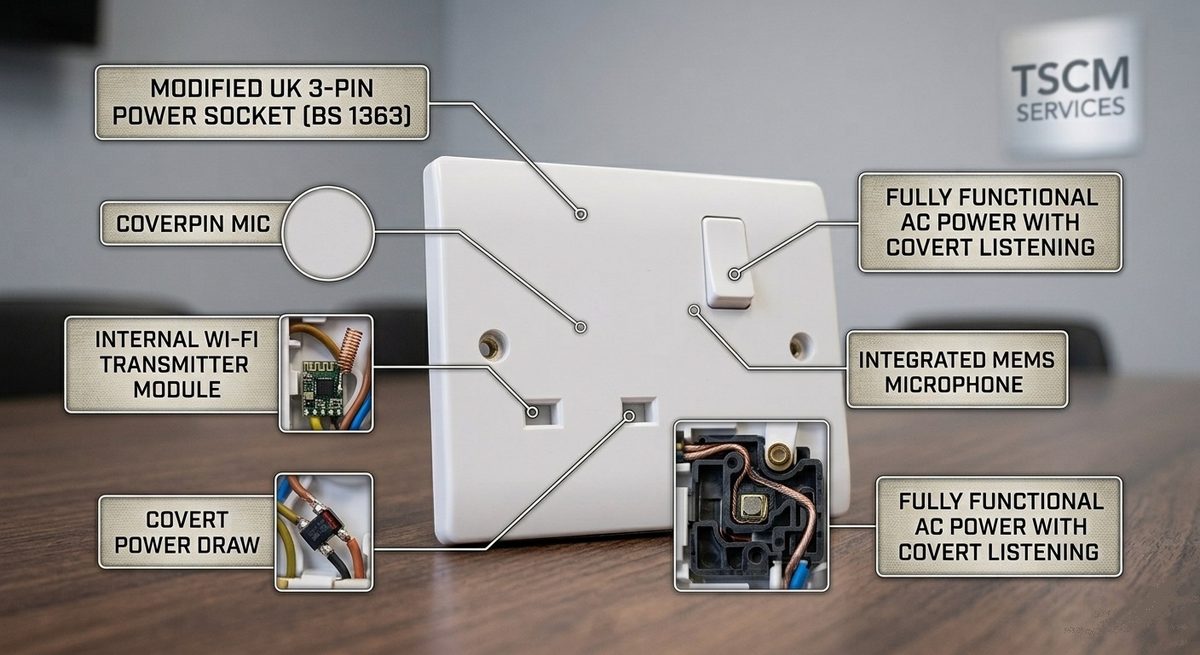
No single detector covers every category. Professional TSCM combines appropriate RF spectrum analysis, physical inspection, electronic and cable examination, network awareness and engineering judgement according to the environment and concern.
From Technical Knowledge to Practical Investigation

Advanced Technical Security Services

K9 Electronics can support work that extends beyond a conventional sweep, including suspect-item laboratory investigation, Trojan-horse item screening, RF baselines, meeting-room privacy assessment and secure fit-out verification.

Explore Advanced Technical Services
Featured Technical Guide

Modern Bugging Devices & Frequencies

Modern surveillance is not confined to one frequency or one type of transmitter. Our UK-focused guide explains traditional RF bugs, cellular devices, Wi-Fi and Bluetooth surveillance, frequency-hopping and burst transmitters, trackers, hidden cameras and non-transmitting devices.

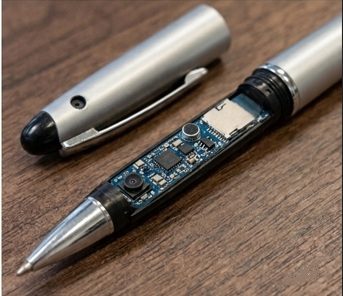
Examples of concealed and miniature surveillance devices
Examples of the varied form factors that covert surveillance electronics can take. A professional inspection must consider both transmitting and non-transmitting devices.
Cornerstone Guide

Modern Bugging Devices & Frequencies – UK Technical Guide

Understand the technologies and radio environments relevant to modern surveillance, and why a professional investigation must consider far more than a list of known bug frequencies.

Read the Technical Guide
Professional TSCM Equipment

K9-NFD-100 Near-Field Detector

A close-range detector designed to help find powered GPS trackers, voice recorders, hidden cameras and other concealed electronics, including devices that may not be transmitting at the time of the search.

4 LIVE CHANNELS

Detect Internal Electronic Activity

POWER, CLOCK, FAST CLOCK and GNSS channels operate simultaneously to support contact-range localisation of powered electronics.

NON-TRANSMITTING DEVICES

Designed for the Gap

Useful when a recorder, camera or tracker may be powered but not intentionally radiating a conventional radio transmission.

UK ENGINEERING

GPS Tracking Device Detector - K9-NFD-100

See the preliminary specification, four detection bands, operating method, limitations and ordering information.

View GPS Tracking Device Detector
Detection & Investigation

Professional TSCM explained

Residential Guide

How Do I Know If My House Is Bugged?

Which signs may justify investigation, which common claims are unreliable, and how a professional home TSCM inspection approaches the problem.

How RF Bugs Are Detected

How spectrum analysis and RF investigation are used to identify and investigate suspicious transmissions.

RF Detector vs Professional TSCM

Why detecting RF energy is not the same as identifying a surveillance device.

Can Bugs Be Detected When Not Transmitting?

Why dormant, intermittent and non-RF devices require complementary inspection methods.

What Happens During a Bug Sweep?

A practical overview of the stages involved in a professional technical inspection.

What To Do If You Think You Are Bugged

Practical, measured guidance for private and corporate clients with surveillance concerns.

Signs You May Be Bugged: Evidence vs Myths

Which observations may justify investigation and which common claims are unreliable.

How To Choose a TSCM Company

Questions to ask about technical capability, methodology, confidentiality and reporting.

Office Bug Sweep: What Should Be Included?

A detailed guide to professional corporate inspection scope, methods and reporting.

Pre-Meeting TSCM

How boardrooms can be inspected and controlled before highly confidential meetings.

Acoustic Privacy Assessment

How confidential speech and authorised wireless signals may leak beyond a meeting room.

Bug Sweeping Birmingham

Engineering-led TSCM for businesses, homes and vehicles across Birmingham and the West Midlands.

TSCM Frequently Asked Questions

Answers to common questions about scope, timescales, pricing and professional bug sweeping.

Signs Your London Office May Be Bugged

Evidence that may justify investigation, common false alarms and practical next steps for London businesses.

Confidential Bug Sweeping: What to Expect

How a discreet TSCM enquiry, inspection and reporting process should work.

Boardroom Bug Sweep London

Preventative TSCM before confidential board meetings, negotiations and legal discussions.

How Secure Is Your Boardroom?

Seven ways confidential information can leave a meeting room beyond a conventional radio bug.

Need a Professional Inspection?

If your concern relates to a home, office, meeting room or vehicle, our technical guides can help you understand the subject. For a specific surveillance concern, contact us confidentially to discuss an appropriate TSCM inspection.

Confidential Enquiry
Professional TSCM Knowledge

How professional surveillance detection is actually carried out

These guides explain the methods, equipment, interpretation and reporting behind a professional sweep — and why consumer detectors cannot provide the same level of confidence.

METHOD

How a Professional TSCM Sweep Is Carried Out

Step-by-step methodology from consultation and RF analysis through physical inspection, anomaly investigation and reporting.

EQUIPMENT

Professional Bug Sweep Equipment

What spectrum analysers, NLJDs, inspection tools and electrical test equipment can — and cannot — tell an investigator.

BENCH TEST

Testing a Cheap Bug Detector

Why an alarm may be a legitimate RF response but still fail to identify a bug, and why silence can create false reassurance.

REFERENCE

TSCM Glossary

Plain-English explanations of RF, NLJD, frequency hopping, false positives, store-and-forward devices and other common terms.

REPORTING

TSCM Reporting & Findings

What a useful report can contain, what happens when something suspicious is found and why limitations should be documented.

CONSUMER DETECTORS

Cheap Bug Detectors: Limitations

False positives, magnetic-detector problems, non-transmitting devices and the limits of broadband field-strength alarms.

WhatsApp Us