Next Step
Professional TSCM Services
Professional surveillance detection for homes, offices, meeting rooms and vehicles.
Concern does not automatically mean surveillance is present. A careful, evidence-led approach is more useful than dismantling a room or relying on a cheap detector.
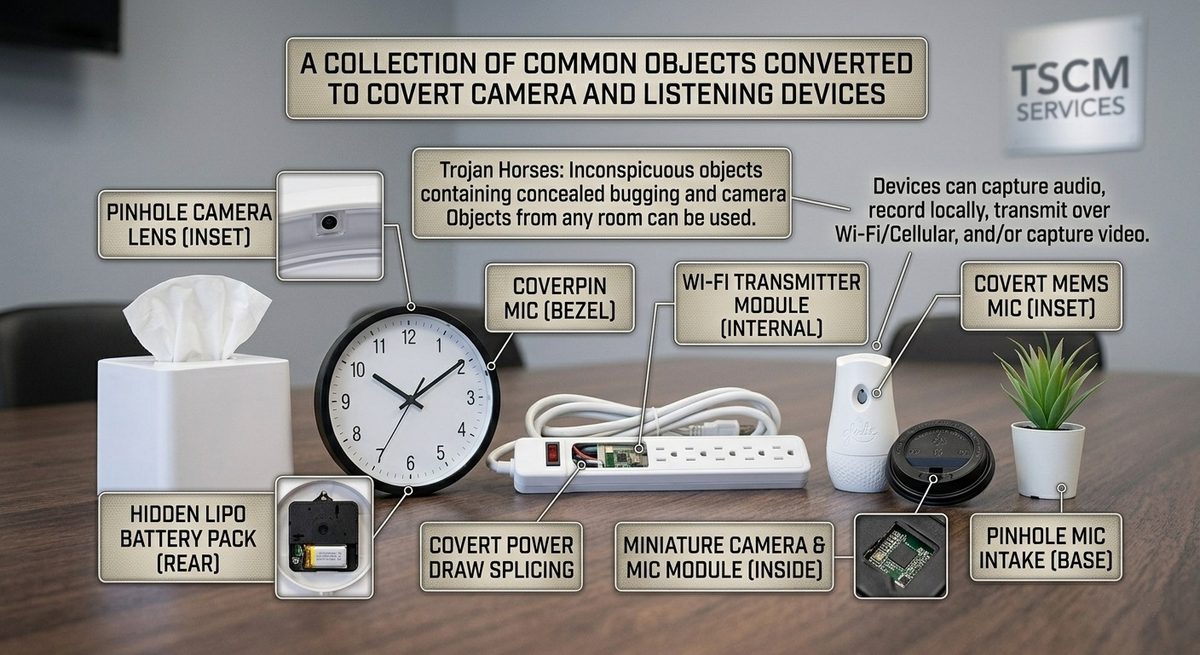
Many ordinary technical problems can resemble surveillance. Interference, unfamiliar Wi-Fi devices, battery drain, clicks or unusual electronic behaviour are not proof of a bug on their own.
If you discover an unfamiliar object that may be relevant, avoid dismantling or repeatedly handling it. Photograph its position and consider professional advice, particularly if the circumstances could become a legal or employment matter.
Write down dates, locations and concrete events that caused concern. Specific information is much more useful to a technical investigator than a general feeling that something is wrong.
If there is a credible concern, limit discussion of the inspection to people who genuinely need to know. Use a communication method you consider appropriate for arranging the survey.
Consumer tools can react to perfectly legitimate cellular, Wi-Fi and Bluetooth transmissions. They can also miss devices that are dormant, hardwired, store information locally or use complex transmission methods.
Think about where confidential conversations occur, who has had physical access, whether vehicles are involved and whether there have been recent changes to fixtures, equipment or cabling. This helps scope an inspection efficiently.
A professional TSCM survey can examine the RF environment and relevant physical or electronic pathways without assuming in advance that a device exists.
If your concern involves an immediate threat to personal safety or a suspected crime, contact the appropriate authorities rather than confronting another person yourself.
Avoid unnecessary disturbance of the environment. Choose a confidential professional route based on where the concern is located.
Professional surveillance detection for homes, offices, meeting rooms and vehicles.
Use our short confidential assessment without providing sensitive names or conversations.
Professional residential investigation for listening devices, cameras and suspicious electronics.