A practical GPS tracking device detector for people who want to check a vehicle, home or office for powered hidden trackers, spy cameras, voice recorders, listening devices and other concealed electronics. It does not rely on the hidden device transmitting at the moment you search.
Near-field detector: the probe is moved close to the surface or object being checked. Preliminary product specification is subject to production qualification.
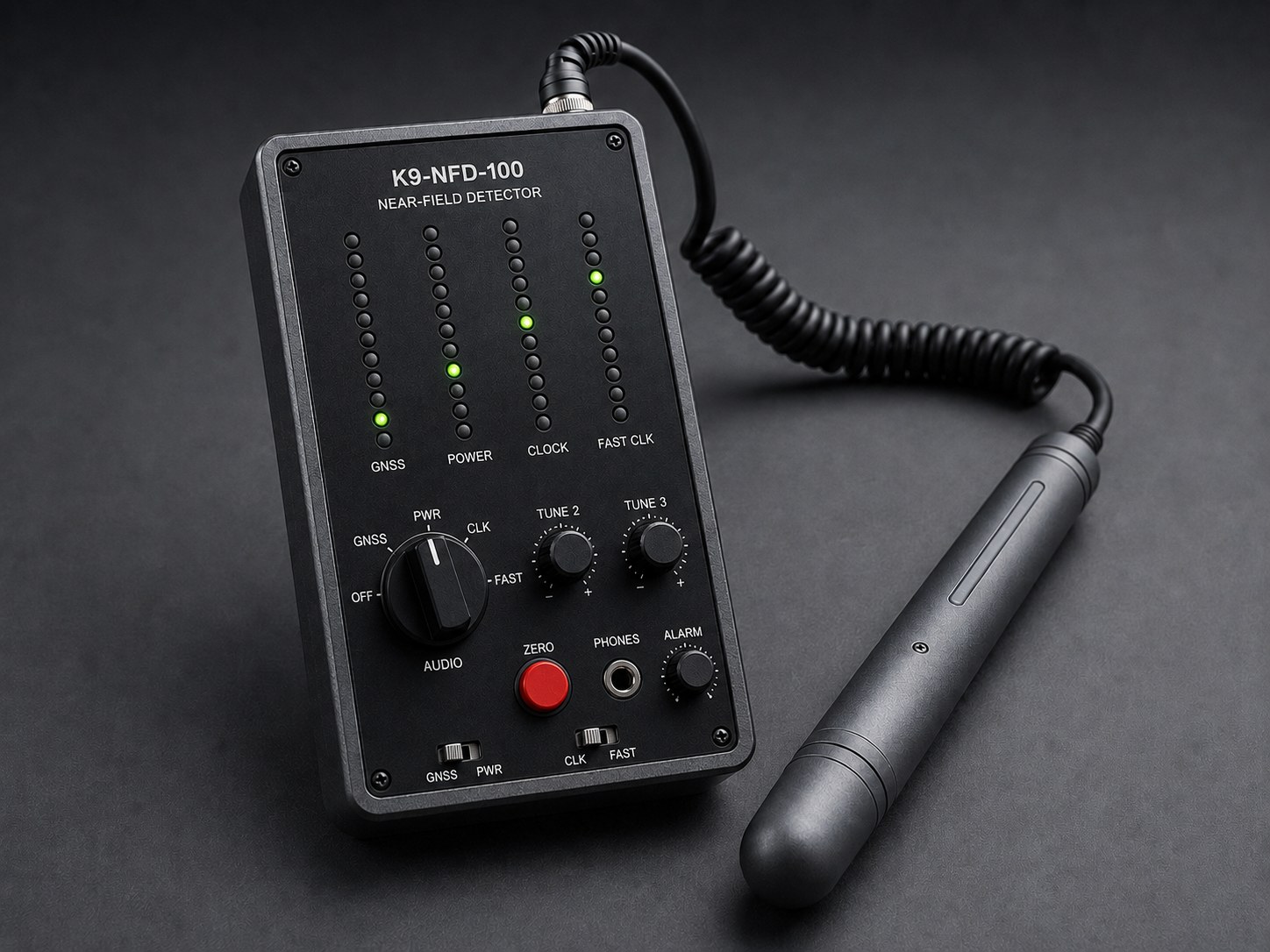
Whether you searched for a GPS tracking device detector, spy camera finder or voice recorder detector, the purpose is simple: help you localise hidden powered electronics without needing to understand frequency bands.
Use the K9-NFD-100 as a close-range GPS tracker detector to help locate a powered tracking device while it is waiting between location reports. The tracker does not have to be transmitting when you pass the probe close to its hiding place.
A concealed recorder may simply save conversations to internal memory or an SD card. It does not need to transmit audio for the K9-NFD-100 to look for its internal electronic activity.
As a spy camera detector, the K9-NFD-100 looks for powered camera electronics at close range. A hidden camera can be found even when it is recording locally to memory rather than sending video over Wi-Fi or radio.
Cellular and other electronic listening devices may spend long periods in standby. The K9-NFD-100 gives you another way to search for the powered electronics even while their radio is quiet.
If you are looking for a GPS detector for a car, the important point is that a hidden tracker may stay quiet for long periods between reports. The K9-NFD-100 is designed for a close-range search of likely hiding places while the tracker remains powered.
Products sold as a GPS transmitter detector may depend on catching the tracker while its radio is active. The K9-NFD-100 does not rely only on that transmission. Move the probe close to seats, trim, the boot, headliner and other accessible areas to narrow down the location of powered tracker electronics.
Many inexpensive RF bug detectors mainly react when something nearby is transmitting a radio signal. That can be useful, but it leaves an obvious gap: some hidden devices transmit only occasionally, while others record locally and may not transmit at all.
| What the hidden device is doing | Typical RF bug detector | K9-NFD-100 |
|---|---|---|
| GPS tracking device sending a location report | May react to the transmission. | Designed to help localise the powered electronics at close range. |
| GPS tracking device waiting between reports | May show nothing while the radio is quiet. | Designed for this type of close-range search while the tracker remains powered. |
| Voice recorder saving to memory | There may be no radio transmission to detect. | Designed to look for electronic activity inside the powered recorder. |
| Camera recording to an SD card | There may be no Wi-Fi or RF transmission. | Designed to help locate the powered camera electronics. |
| Device with no power / flat battery | Cannot detect a transmission that does not exist. | Cannot detect fully unpowered electronics either. |
The front panel uses simple LED columns rather than asking the user to interpret a spectrum display or a list of frequency numbers.
Set the detector to the normal background in the area you are checking.
Pass the probe close to vehicle trim, seats, furniture, desks, fittings or the object you want to check.
When the response rises, move the probe around that area to narrow down where the electronic activity is strongest.
Use it as a GPS tracking device detector for cars by checking seats, trim, boot areas, headliners, accessible wheel-arch areas and other possible hiding places for powered tracker electronics.
Sweep desks, furniture, fittings and suspicious objects where a hidden recorder, camera or listening device may have been placed.
Investigate an item that seems out of place or that you suspect may contain concealed powered electronics.
We would rather state these clearly than give a buyer unrealistic expectations.
If a device has a flat battery, no battery or is completely disconnected from power, this detector cannot find it from powered emissions.
This is not a detector you point across a room. The probe is deliberately used close to surfaces and objects so you can narrow down the location.
Normal electronics can also produce a response. Once you locate electronic activity, you still need to identify the item and decide whether it belongs there.
The webpage is deliberately written for buyers. Engineers and professional TSCM users can download the full datasheet for the exact detection bands, sensors, tuning, operating range and preliminary specification.
For people who want to find hidden trackers, spy cameras, voice recorders and other powered electronic devices without relying only on a radio transmission. Supplied as a complete detector and probe kit.
Yes - it is designed to help locate a powered GPS/GNSS tracking device when you pass the probe close to where it is hidden. Importantly, the tracker does not have to be actively sending a location report at that moment.
Yes - this is one of the main reasons for the product. A powered recorder may save audio locally without transmitting anything. The K9-NFD-100 is designed to look for electronic activity inside the recorder itself.
Yes - for powered hidden cameras. The K9-NFD-100 works differently from a simple optical lens finder: it is designed to locate electronic activity close to the concealed camera, including cameras recording locally to a memory card rather than transmitting video.
No. If the electronics are completely unpowered there is no powered activity for this type of detector to sense. A physical inspection or a different specialist method is then required.
No specialist frequency interpretation is required for the basic search. Press ZERO, move the probe close to the area being checked, and use the LED and alarm response to narrow down the location. Experienced users can also use the audio monitor for additional information.
This is intentionally a close-range detector. The probe is normally used at contact distance to a few centimetres from the surface being searched.