A voice recorder detector is used to help locate concealed electronic recorders that may have been placed in a room, office, vehicle, bag, furniture or everyday object. The important difficulty is that a hidden recorder does not necessarily need to transmit anything. It can simply store audio internally and remain radio-silent while it records.
What kind of hidden recording devices can be difficult to find?
Local voice recorders
Small recorders can save conversations to internal memory or a memory card and may never transmit audio by radio.
Disguised recording devices
Electronics may be concealed inside ordinary objects, adapters, furniture, fittings or other items that do not immediately look suspicious.
Standby electronic bugs
Some devices spend long periods quiet and only transmit or activate at particular times, making a simple RF-only search less reliable.
Powered concealed electronics
A close-range electronic detector can support the search for powered devices even when there is no obvious transmission to follow.
Why an RF bug detector can miss a hidden voice recorder
Many inexpensive bug detectors mainly react to active radio transmissions. That can be useful for a transmitting microphone or wireless camera, but a hidden recording device can capture audio and save it locally without deliberately sending a radio signal. In that situation there may be nothing obvious for a conventional RF detector to alert on.
This is why a recorder search should not rely on one detection method alone. The closer the detector can work to the suspected object or surface, the easier it is to narrow the response down to a specific item rather than simply detecting general radio activity in the room.
For the practical search process, see How to Find a Hidden Voice Recorder, covering physical inspection, phone limitations, close-range electronic detection and professional TSCM methods.
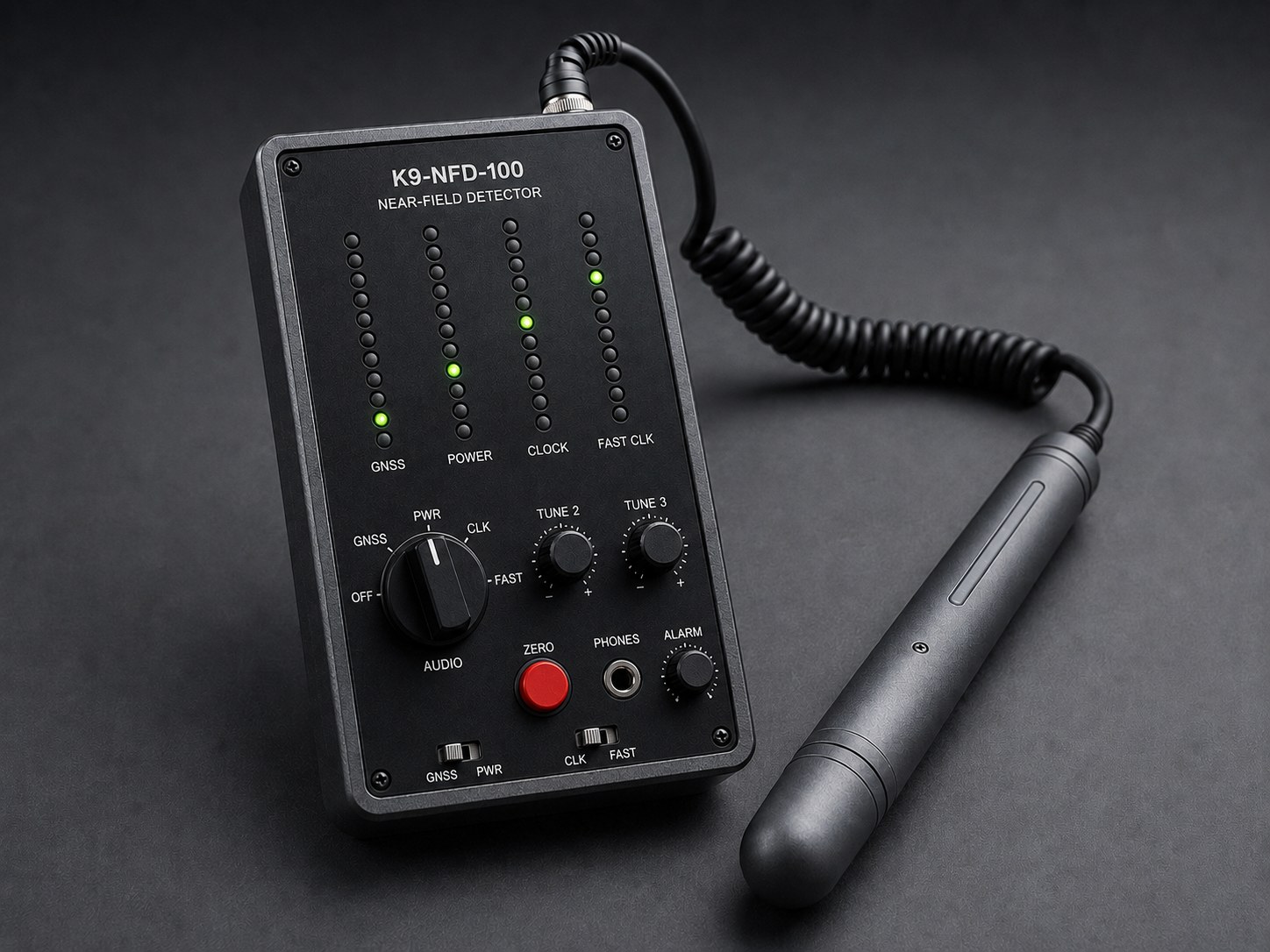
K9-NFD-100 for powered hidden voice recorders
The K9-NFD-100 Near-Field Detector is designed to help locate powered hidden electronics at close range. It is particularly relevant when a voice recorder, listening device, camera or tracker may be powered but not actively transmitting.
Find the electronics, not just a radio transmission
For a powered recorder, the objective is to localise the electronic device itself. The K9-NFD-100 is moved close to furniture, fittings, objects or vehicle trim and the operator follows the response toward the source.
Price: £795 + VAT · Free UK shipping · Pre-order
What a voice recorder detector cannot prove
No handheld detector can guarantee that every possible recorder is absent. A completely unpowered device has no powered activity for this type of detector to locate. Professional searches may therefore combine close-range electronic detection with physical inspection and, where appropriate, other specialist techniques such as non-linear junction detection.
Detector or professional sweep?
If you want equipment for your own searches, the K9-NFD-100 provides a dedicated close-range detection option. If the consequences of missing a device are significant, a professional TSCM inspection can combine multiple search methods, physical inspection and operator judgement.
Related: Listening Device Detector Guide · Detecting Non-Transmitting Devices · Professional TSCM Services
Frequently asked questions
Can a detector find a hidden voice recorder that is not transmitting?
A radio-only detector may miss it. A close-range detector designed to locate powered electronic activity can provide another search method while the recorder remains powered.
What type of voice recorder is hardest to find?
A small locally recording device can be difficult to find because it may save audio internally without deliberately transmitting a radio signal.
Can the K9-NFD-100 find a hidden recording device?
It is designed to help localise powered hidden electronics such as voice recorders at close range, including devices that may not be actively transmitting.
Can it detect a recorder with no power?
No. A completely unpowered recorder produces no powered electronic activity for this type of detector to locate. Physical inspection or another specialist technique is required.