Next Step
Professional Detection Equipment
Explore specialist equipment for tracker, listening-device and hidden-electronics searches.
Low-cost handheld bug detectors sold through online marketplaces and spy shops can be useful as rough RF indicators, but they are not a reliable substitute for a professional TSCM investigation. The biggest risks are false alarms — and false reassurance.
Many inexpensive products combine a broadband RF sensor with extra features such as a camera-lens viewer or a so-called magnetic detector. These functions can sometimes be useful, but they do not identify a surveillance device. They simply react to a physical quantity such as radio energy, reflected light or magnetic field strength.
Quality varies widely between devices sold on Amazon, eBay and specialist spy shops. A simple RF detector may help a user notice a strong nearby transmitter. What it cannot do is tell you whether that transmitter is a bug, a mobile phone, Wi-Fi, Bluetooth, a wireless alarm, a smart device or another legitimate source.
The problem is therefore not only detection. It is identification and interpretation.
A UCL-led study of 34 participants using 19 consumer hidden-device detection tools found that participants equipped with detectors still missed 58.8% of concealed surveillance devices. The researchers highlighted the importance of understandable, actionable feedback rather than sensing capability alone.
| Situation | Low-cost RF / multi-function detector | What the result actually means |
|---|---|---|
| Strong continuous RF transmitter nearby | May give a useful indication | Shows RF energy is present, not what produced it |
| Mobile phone, Wi-Fi or Bluetooth device | Often triggers | Common source of false suspicion |
| Frequency-hopping / short burst transmission | May react briefly or miss it | Usually cannot identify or follow the signal behaviour |
| Very low-power transmitter | May be missed | Detection depends on power, distance, frequency coverage and environment |
| Store-and-forward recorder | No RF indication while recording locally | Silence does not mean the device is absent |
| Voice recorder / local memory device | No RF indication required | An RF detector has nothing to receive |
| Switched-off or dormant electronics | No RF indication | Other inspection methods are required |
| Hardwired microphone | May give no RF indication | Physical/cabling investigation may be needed |
| Strong magnet | Magnetic mode may alarm | Does not prove the object is a tracker |
| Hidden camera lens | Optical viewer may sometimes help | Requires line of sight and careful visual inspection |
Homes, offices and vehicles are full of legitimate radio transmitters. Wi-Fi routers, mobile phones, Bluetooth accessories, cordless equipment, wireless alarms, smart-home devices and neighbouring transmitters can all create genuine RF energy. A broadband field-strength detector typically has no way to identify which service produced the signal.
Turning the sensitivity up does not make the instrument more intelligent. It can simply make it react to more legitimate signals.
A false positive does not necessarily mean the detector is faulty. The detector may be correctly sensing radio energy while the user incorrectly assumes that radio energy must be a listening device.
Modern digital surveillance does not have to sit on one continuous radio frequency. A transmitter may send very short bursts, change frequency, remain quiet for long periods or use an existing communications network. A cheap broadband detector may flash or beep during some transmissions, but it generally cannot show the frequency pattern, bandwidth, timing or protocol needed to understand what the signal actually is.
This is why saying that these detectors “cannot detect frequency hopping” is too absolute: some may react to individual bursts. The real limitation is that they can miss brief activity and cannot reliably identify or characterise a hopping signal.
A store-and-forward device records audio or other data locally and transmits it later. A conventional voice recorder may never transmit at all. Similarly, some surveillance equipment can sleep for long periods and wake only at scheduled times or after a trigger.
When nothing is transmitting, an RF detector has nothing to detect. This is one of the most important limitations of relying on a single consumer detector.
Some low-cost bug detectors advertise a magnetic-field function as a way to find magnetically mounted GPS trackers. The principle sounds attractive because many battery trackers can be fitted underneath vehicles with strong magnets.
The limitation is that detecting a magnetic field is not the same as detecting a tracker. Loudspeakers, motors, magnetic catches, mounts, tools, vehicle components and other magnetic or ferromagnetic objects can affect the reading. Conversely, a tracker may be screwed, taped, cable-tied, hidden behind trim or hardwired into the vehicle and contain no external mounting magnet at all.
On a vehicle in particular, the result has to be interpreted alongside a systematic physical inspection. A magnetic alarm by itself cannot identify the object, establish whether it is legitimate or prove that a tracker is present.
A customer may sweep a room with a £30–£100 detector, hear no alarm and conclude that the room is clear. That conclusion is not justified. Non-transmitting devices, local recorders, hardwired systems, intermittent transmitters, low-power signals and devices outside the detector's useful frequency range can all escape a simple RF check.
In professional counter-surveillance work, “no alarm” is therefore not treated as evidence that no surveillance exists.
Used with realistic expectations, a basic detector can be useful for learning about the RF environment, confirming that a strong transmitter is active nearby, or helping to compare signal strength while moving around a controlled area. It can also prompt a sensible question when something genuinely unusual is discovered.
What it should not be used for is making a definitive statement that a home, office, meeting room or vehicle is either bugged or clear.
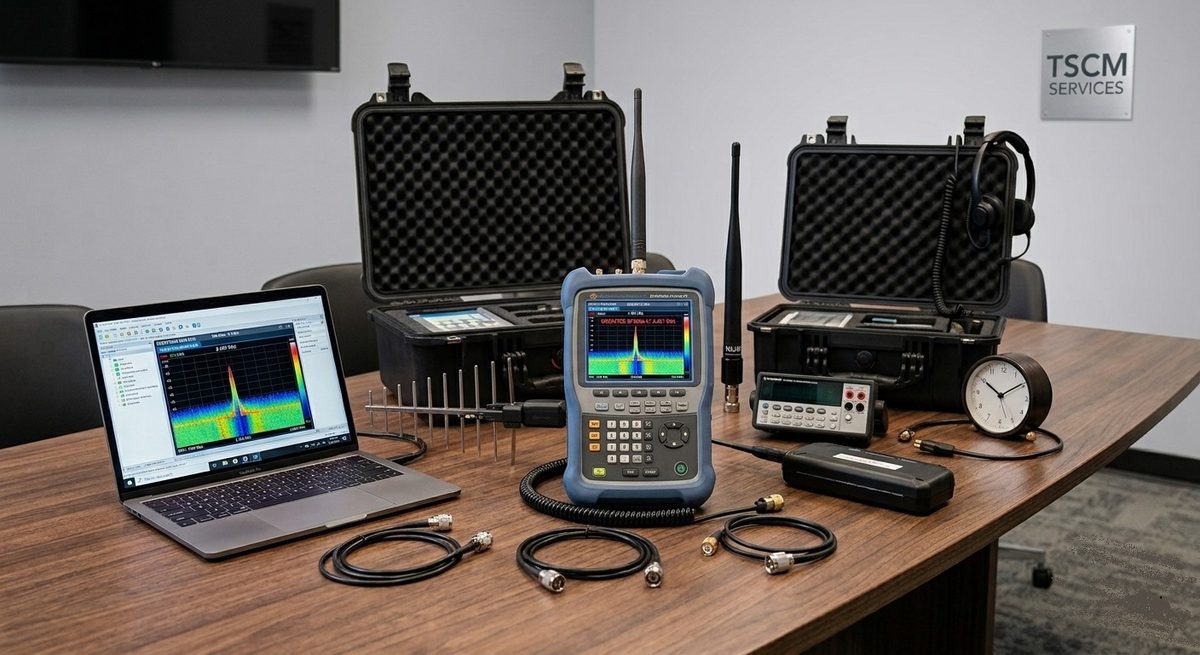
A professional investigation does not depend on one detector. Depending on the environment and agreed scope, it can combine spectrum analysis, RF localisation, physical inspection, optical examination, investigation of wiring and electronics, non-linear junction detection and other appropriate methods. Results are then interpreted against the legitimate electronic environment.
Professional tools also have limitations. For example, an NLJD can identify semiconductor electronics even when they are not powered, but legitimate electronics and some material junctions can also respond, so the reading still needs technical interpretation. Professional TSCM is therefore a process, not a magic detector.
A professional TSCM investigation asks: What is it? Where is it coming from? Does it belong here? What threats would this detector never see?
They can detect some strong active RF sources and some models include useful optical or magnetic features. They are not reliable proof that a surveillance device is present or absent.
They may respond to individual transmissions if the signal is active and strong enough, but short bursts are easy to miss and basic detectors normally cannot identify or follow the hopping pattern.
No. A local recorder or store-and-forward device produces no useful RF signal while it is recording silently.
No. It only indicates a magnetic field or disturbance. The source may be entirely legitimate, and many trackers are not magnetically mounted.
If the concern requires identification rather than a simple indication, compare professional detection equipment or a full TSCM investigation.
Explore specialist equipment for tracker, listening-device and hidden-electronics searches.
A layered professional investigation rather than reliance on one detector.
Near-field detection for powered hidden electronics that may not be actively transmitting.