Next Step
Professional Detection Equipment
Explore specialist detector equipment built for specific surveillance-search tasks.
Low-cost bug detectors can react to real RF energy, magnets and reflections — but an alarm is not the same as identifying surveillance. Here is how an engineering bench test separates the two.
Low-cost multi-function “bug detectors” are widely sold online with RF, camera-lens and magnetic detection functions. The useful engineering question is not whether the product can ever beep. It is whether the indication lets a non-specialist make a reliable conclusion about surveillance.

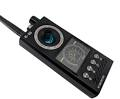
Illustrative consumer detector. Features and performance vary widely by model.
This is an engineering guide to the limitations of this class of detector, not a certification or condemnation of one specific model. Exact sensitivity, frequency coverage and magnetic/optical performance vary between products.
A 2026 UCL-led study evaluated 19 widely available hidden-device detection tools with 34 participants searching simulated living rooms. Participants using a detector still missed 58.8% of hidden surveillance devices, compared with 66.7% when searching without one.
The researchers found that effectiveness depended heavily on whether the detector gave users information they could understand, verify and act upon — not simply whether the instrument sensed something. This supports an important TSCM principle: detection is only the first step; identification and interpretation matter.
Research context: the study assessed consumer detection tools and user interaction; it was not a direct comparison with professional TSCM services. Read the UCL summary · Read the SOUPS 2026 research paper
A controlled evaluation can present known signals or known objects to the detector and observe its response. The key is then to ask what the alarm actually proves. A broadband detector may be working exactly as designed while still giving the user too little information to identify a surveillance device.
| Test condition | Typical low-cost detector behaviour | What the result proves |
|---|---|---|
| Strong continuous RF source close to detector | Often gives a clear alarm or rising level | RF energy is present nearby; not what the transmitter is |
| Mobile phone transmitting data or making a call | Often alarms strongly at close range | A legitimate cellular transmitter can look “suspicious” to the detector |
| Wi-Fi router / access point | May alarm depending on distance and sensitivity | Normal network traffic is enough to create a positive indication |
| Bluetooth / short burst activity | May flicker, alarm intermittently or be missed | Short duty cycle and low power make simple alarm interpretation difficult |
| Frequency-agile / hopping transmission | May respond to some bursts but not consistently | The detector normally cannot show the hopping sequence or identify the signal |
| Local voice recorder with no radio | No useful RF indication | An RF detector cannot detect a radio signal that does not exist |
| Powered-off electronic device | No RF alarm simply because electronics are present | Other inspection methods are required |
| Strong magnet, speaker or motor near magnetic sensor | Magnetic mode may alarm | A magnetic field is present; not that a GPS tracker has been found |
If a detector alarms beside a Wi-Fi router, phone or Bluetooth device, it has not necessarily failed. It may be detecting real electromagnetic energy. The false positive occurs when the user interprets that generic response as evidence of a hidden bug.
Turning sensitivity higher often increases the number of alarms without increasing the instrument's ability to identify their sources.
The absence of an alarm can create false reassurance. A local recorder, store-and-forward device, switched-off transmitter, hardwired microphone or very low-power intermittent signal may not create a useful response. A detector also has finite frequency coverage and dynamic range.
A magnetic sensor can be useful for locating a strong magnet, but a magnet is not the same thing as a tracker. Vehicle loudspeakers, motors, catches, mounts and many ordinary components can influence the reading. Meanwhile a tracker may be taped, screwed, cable-tied, concealed behind trim or hardwired and have no external mounting magnet at all.
Known RF sources, attenuators, signal generators, spectrum analysis and controlled distances allow an engineer to explore sensitivity, selectivity, response time and blind spots. More importantly, the test demonstrates the difference between detecting energy and identifying a surveillance threat.
It may help a user notice a strong active transmitter or inspect for an obvious camera reflection or magnet, but it cannot by itself establish that a home, boardroom or vehicle is either bugged or clear.
A low-cost detector can indicate activity, but professional work depends on suitable equipment, interpretation and complementary methods.
Explore specialist detector equipment built for specific surveillance-search tasks.
Dedicated equipment for powered hidden bugs, voice recorders and concealed electronics.
A complete investigation using multiple techniques rather than one handheld detector.