Next Step
GPS Tracker Detector
Explore the K9-NFD-200 GPS tracker detector for close-range vehicle searches.
A practical guide to finding hidden GPS trackers and other tracking devices on a vehicle, including what you can check yourself and when specialist detection equipment helps.
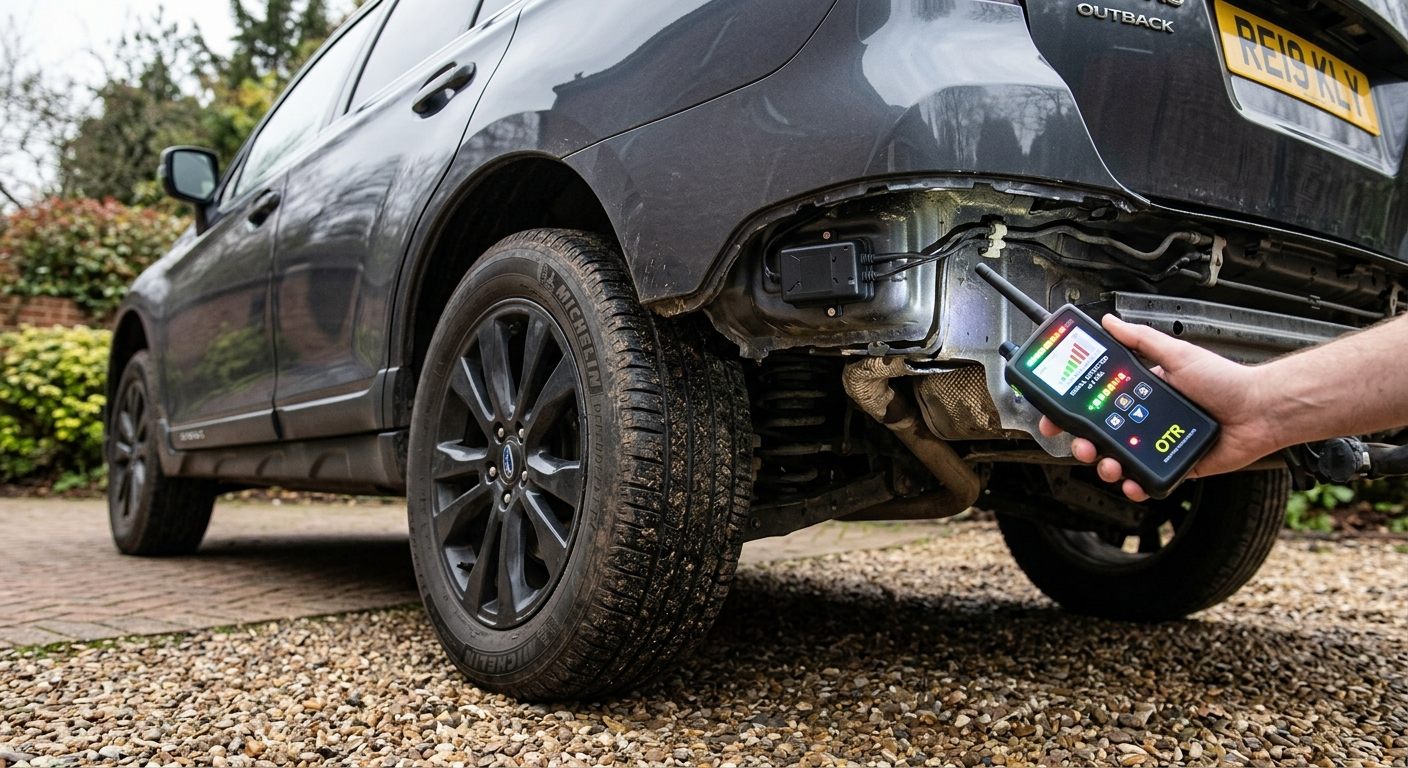
If you are trying to find a tracking device on a car, start with the simple checks first. Some trackers can trigger a phone alert or be found visually, while others are hidden behind trim, attached underneath the vehicle or remain quiet for long periods. No single method finds every possible device.
A sensible search works from the least intrusive checks to the more specialist ones. Check any unwanted-tracker alerts on your phone, inspect accessible areas of the vehicle for anything unfamiliar, and look for signs of an added box, cable, magnet or adhesive mounting. Do not dismantle airbags, safety systems or vehicle wiring unless you are competent to do so.
Vehicle tracking devices range from small Bluetooth tags to dedicated GPS/GNSS trackers that send their position over a cellular network. Some are battery powered and magnetic, while others may be wired into the vehicle. A tracker may transmit frequently, occasionally or only after movement, so the search method needs to match the type of device.
Modern iPhone and Android unwanted-tracker warnings are valuable for supported Bluetooth tags and should be used. They do not, however, turn a phone into a universal GPS tracker detector. A dedicated cellular tracking device may have no Bluetooth signal for the phone to identify.
For a step-by-step phone-specific check, see How to Find a GPS Tracker With Your Phone, including iPhone/Android tracker alerts and the types of tracker a phone may miss.
A broadband RF detector only reacts when sufficient radio energy is present. A tracker that is between transmissions may give little or no useful response at the moment you search. Modern cars also contain legitimate cellular, Bluetooth, Wi-Fi, keyless-entry and telematics systems, so an RF indication on its own does not prove a tracker is present.
A professional GPS tracker detector is useful when the aim is not merely to know that radio activity exists, but to localise the physical hiding place. Close-range detection lets the operator compare one part of the vehicle with another and narrow the response down around wheel arches, seats, trim, bumpers and other accessible areas.
The K9-NFD-200 GPS Tracker Detector is being developed specifically for this type of search, including GPS trackers, Bluetooth tags and other powered hidden electronics.
An emission-based detector needs some form of powered activity to detect. A completely unpowered electronic device may require physical inspection or a different technique such as non-linear junction detection (NLJD). This is why professional vehicle TSCM uses more than one detection method.
The scope depends on the vehicle and concern, but may include a structured physical search, assessment of accessible wiring and unusual additions, electronic and RF checks, close-range localisation and further examination of anything suspicious. Where underside access is required, the vehicle should be raised safely on appropriate professional lifting equipment or inspected over a suitable pit.
Our engineering-led vehicle bug sweeps combine electronic investigation with physical inspection. Workshop vehicle sweeps start from £495, with the correct tier confirmed from the vehicle make, model and fitted electronics.
Related equipment guides: Professional GPS tracker detector buyer guide · Car bug detectors explained · K9 detection equipment
Modern vehicle electronics: Why eCall, telematics and factory electronics can complicate tracker detection
Choose between dedicated tracker-detection equipment and a professional vehicle investigation.
Explore the K9-NFD-200 GPS tracker detector for close-range vehicle searches.
Professional vehicle TSCM and GPS tracker detection from our workshop.
See what to look for when choosing professional GPS tracker detection equipment.