A professional GPS tracker detector should do more than beep when a radio signal is nearby. A vehicle already contains many legitimate transmitters and electronic systems, while a hidden tracker may spend long periods quiet. The useful question is whether the detector helps you find and localise the actual tracking device.
Not all tracker detectors work the same way
Phone alerts
Useful for supported Bluetooth tracking tags. Free and worth checking first, but not a universal tracking device detector.
Broadband RF detectors
React to active radio energy. Useful when a tracker is transmitting, but modern vehicles contain many legitimate signals.
Close-range tracker detectors
Designed to help narrow the search down to the physical hiding place rather than simply indicating that something is somewhere nearby.
Professional TSCM
Combines electronic detection with physical inspection and other techniques when one detector alone is not enough.
What kinds of tracking devices do you need to find?
A buyer choosing a tracking device detector should consider both dedicated GPS/cellular trackers and Bluetooth location tags. The search may also need to distinguish a covert device from the vehicle's own telematics, keyless-entry, Wi-Fi and Bluetooth systems.
Why quiet trackers matter
A tracker does not necessarily transmit continuously. If a detector relies only on catching an RF transmission, the result can depend on whether the device happens to send data while you are looking. For a serious vehicle search, it is useful to have a method that can help investigate powered electronics at close range even between transmissions.
Why localisation matters
Detecting a signal in a car park is not the same as finding a box behind a bumper. A professional detector should help the operator compare one location with another so the search can be narrowed down around wheel arches, seats, trim, boot areas and accessible bodywork.
Features worth looking for in a professional GPS tracker detector
- Coverage of more than one tracker type — for example GPS/cellular trackers as well as Bluetooth tags.
- Close-range localisation — so you can work towards the strongest physical location.
- Clear indication — the operator should be able to understand what changed without interpreting meaningless random alarms.
- Useful around modern vehicles — where legitimate electronics create a busy background.
- Honest limitations — no detector should claim to find every device in every condition.
K9-NFD-200 GPS Tracker Detector
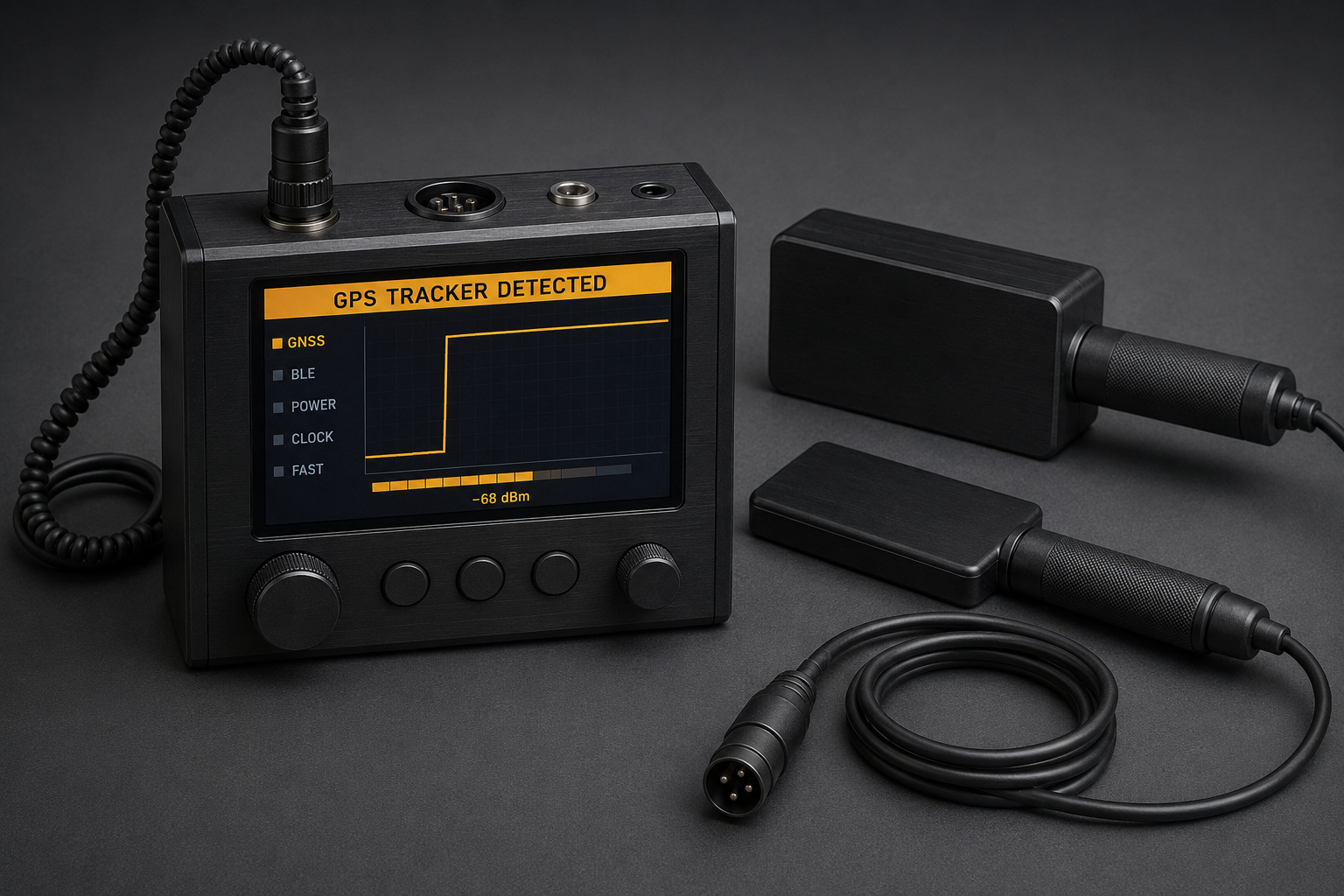
The K9-NFD-200 is being developed as a professional GPS tracker detector for close-range vehicle searches. It uses interchangeable sensor heads for GPS/Bluetooth tracker searches and for other powered hidden electronics, with a colour display showing the live response as the operator moves around the search area.
See the K9-NFD-200
The K9-NFD-200 is currently in development. There is no purchase path yet, but you can view the product page and register for a one-time availability notification.
Related: How to find a GPS tracker on a car · Car bug detectors explained · Professional vehicle tracker search service
Frequently asked questions
Can one GPS tracker detector find every tracking device?
No. Trackers use different technologies and may be transmitting, quiet, powered or completely unpowered. The most reliable search combines the right electronic detector with physical inspection and, where appropriate, other TSCM methods.
Can a phone find a GPS tracker on a car?
A phone can provide unwanted-tracker warnings for many supported Bluetooth tags, but it is not a universal detector for dedicated cellular GPS trackers.
What is the best GPS tracker detector for a car?
The best detector depends on the threat you need to find. For vehicle work, useful features include coverage of common tracker types, close-range localisation, clear indication and the ability to work when a powered tracker is quiet between transmissions.
Can a detector find a tracker with a flat battery?
An emission-based detector cannot detect electronic activity from a completely unpowered device. Physical inspection or another technique such as NLJD may be needed.