Next Step
Professional TSCM Services
Professional surveillance detection for homes, offices, meeting rooms and vehicles.
There is no reliable checklist of household symptoms that proves a listening device is present. The strongest indicators are usually contextual and evidence-based.
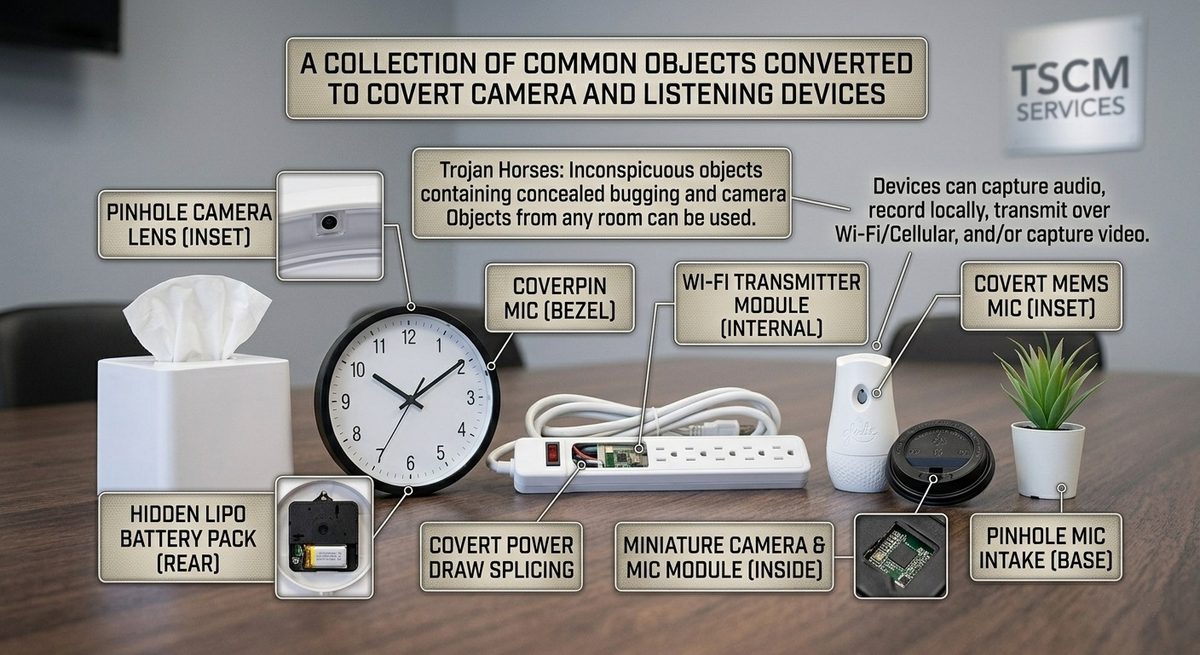
Clicks on calls, radio interference, warm chargers, unusual battery use or unfamiliar wireless names can all occur normally. None should be treated as proof of surveillance in isolation.
Concern may justify further investigation when confidential information repeatedly appears to be known by someone who should not have access, an unexplained device or modification is found, there has been unauthorised physical access, or a credible security incident has occurred.
A new adaptor, charger, cable, smoke detector, USB device or other object is not automatically suspicious. What matters is whether its presence is unexplained and whether technical examination shows functionality inconsistent with its apparent purpose.
Modern homes and offices contain many legitimate transmitters. A new Wi-Fi or Bluetooth identifier may deserve investigation, but identification and localisation are needed before drawing conclusions.
Repeated disclosure of genuinely private information can be more significant than electronic symptoms, although human disclosure, compromised accounts and ordinary information security failures should also be considered.
Unexpected knowledge of a vehicle's movements may justify a physical and electronic inspection, but location information can also leak through phones, apps, shared accounts and connected-vehicle services.
A good TSCM investigation attempts to disprove ordinary explanations as well as investigate surveillance. Finding RF energy is not the same as finding a bug.
Signs alone cannot confirm surveillance. The next practical step is to choose the relevant service or complete a confidential assessment.
Professional surveillance detection for homes, offices, meeting rooms and vehicles.
Residential TSCM for hidden listening devices, cameras and suspicious electronics.
Use a short confidential assessment if you are unsure where to start.